The time has finally come for getting your 2013 Bowen Nature Club membership and attending our Annual General Meeting!
Where & When:
This year it will be held on February 16th at the home of D.G. Blair.
Email bowennatureclub at gmail dot com for address.
It is a potluck and starts at 5:30pm.
Our Speaker: Dr Andrew Trite
Dr Andrew Trite is an amazing speaker and world renown researcher on Steller sea lions.
Dr Trite has been studying North Pacific marine mammals for over 20
years and his research is primarily focused on Steller sea lions,
northern fur seals, and harbor seals. His research program involves
captive studies, field studies and simulation models that range from
single species to whole ecosystems. His goal is to further the
conservation and understanding of marine mammals; providing insights
that can be used to resolve conflicts between people and marine mammals.
He is involved in many projects including those measuring how the
distribution of different species (walrus, fur seals, kittiwakes,
murres, pollock and bivalves) are controlled by fishing, predators, food
availability as well as changes in the physical environment that can
act alone or in concert to alter the species ecosystems. He will provide
a presentation on his research trying to understand the disappearance
of Stellar sea lions from the Gulf of Alaska and the Aleutian Islands.
He has been testing three contributing factors: 1) predation by killer
whales; 2) competition with existing fisheries and 3) reproductive
failure due to changes in diet. He will link this work back to his new
research program trying to determine how Harbour seals in the Strait of
Georgia (highest density of harbour seals found anywhere in the world)
influence sockeye, chinook and coho salmon populations in BC. Dr. Trites
is a Professor at UBC's Fisheries Center and Director of UBC's Marine
Mammal Research Unit and the North Pacific Universities Marine Mammal
Research Consortium.
Membership Outings:
This year we have some exciting adventures planned, including an Owl
Prowl, Invasive Plant Walk, Howe Sound Boat Tour, Reifel Bird Sanctuary,
Family Camping Trip, a bug and insect walk, the annual Sea Creature
Dive, and a hike over Collins Ridge. Also, in addition to the continuing
weekly (F)unschool outings, we will be offering a 3-day (F)unschool
camp during Spring Break!
Bowen Nature Club has affordable annual memberships ($22/family or
$18/single), which give you emailed notices of our outings, attendance
to members-only outings, BC Nature Magazine, and insurance coverage for
our outings.
If you would like to purchase a membership at the AGM: Get a membership form from a director, fill in both pages, and hand it back with your payment.
If you would like to purchase a membership by mail:
Email bowennaturclub at gmail dot com to ask for a membership form,
print and fill in both pages once you get it, and mail it with your
payment (cheque made out to Bowen Nature Club) to our director in charge
of membership (you'll be given her address when the form is emailed to
you, because I don't want to post it on a public forum and increase her
junkmail burden!).
Sunday, February 10, 2013
Friday, February 8, 2013
(F)unschool along Killarney Creek

 |
| The leg bone's connected to the hip bone! |
In addition to our continuing weekly outings, (F)unschool will be convening for a 3-day "camp" during March break, entitled Beach, Bog, and Bluffs. Maybe you can guess where we'll be going...

 |
| Sitting on the upended tree roots. |
 |
| This was a very exciting fireworks show, with "fireworks" made of tiny broken twigs, which the audience is welcome to catch! |
 |
| Fairy garments. |
Saturday, October 20, 2012
Bowen Nature Club Mushroom Walkabout
Saturday, November 10th at 1 pm
Meet in front of the library to car pool to
our field location
Join coastal BC mushroom expert John Field,
Ph.D on a walkabout to find some of Bowen’s mushrooms. We will have a leisurely stroll of about 2
hours seeking out mushrooms that we find along the way – picking our route
based on current conditions. Due to the popularity of this event and our aim to
make this as interactive as possible, this is a free but members-only
event limited to 20 people. Please pre-register with DG at dgbwh@telus.net. You may also call DG (-0134) with any
questions or to pre-register.
Friday, September 28, 2012
Today, forester and conservationist Everhard van Lidth de Jeude led the Nature Club (F)unschool group on a walk into Fairy Fen Nature Reserve (formerly Mystery Fen), with the intention of hanging up some signs there. They are very nice, metal-clad signs, welcoming visitors to Fairy Fen Nature Reserve, and alerting them to its status as a "Reserve", with icons declaring no cycling, no dirt-biking, and no ATV's. The kids were interested, and helped to carry the signs down, as Everhard led them through the woods toward the fen, explaining interesting natural and human processes as we witnessed their evidence along the way; pointing out various types of vegetation, etc. Then...
"What's that sound?"
"It sounds like a truck."
"A chainsaw?"
"No I think it's a quad."
We trekked into the Nature Reserve, and the sounds of the quad disappeared in the distance, but we immediately found the fresh clods of mud it had churned up, and its tracks leading away from the other "Fairy Fen Nature Reserve" signs hung by other Conservancy members.
What a learning experience for the kids!
Everhard then took us to the edge of the fen, and pointed out all sorts of interesting plant life; talked about the provenance of the fen and surrounding boggy new forest, from what was probably once a lake. He told us that somebody had come with expandable rods to measure the depth of the fen, but that he had stopped when he ran out of rods at about 8 feet. We went around the fen, to find the site of a long-ago landslide, and deep grooves in the mountainside probably caused by logs being hauled down the slope when the place was logged many decades ago.
And all the way around the fen, the kids made note of the small devastations (and litter) left by quads and bikes. Fairy Fen was made a preservation area for a reason; it's a sensitive ecosystem and a beautiful area, and it's especially suitable for helping our island's youth to understand the importance of our natural home. Today they learned about its fragility and its need for protection.
Thursday, August 30, 2012
Howe Sound & McNab Creek Boat Tour
When I told my three year-old about the barnacle-eating bear we saw, he
asked 'Were you very brave and didn't scweam?' I have to admit that
floating along in the Apodaca on such a beautiful day, it was hard to
feel intimidated by the big ball of fur on shore. And he didn't seem
very concerned about us. It's the first time for years that I've seen a
bear, and what a privilege to observe one in his natural environment,
doing ‘normal’ bear things. Not going through garbage cans or scrumping
apples, but eating barnacles from the rocks of beautiful, pristine
coastal bluffs. Equally unimpressed by our visit was the bald eagle,
aloof and perfect in his white and black outfit, eagle-eyes glowering
and looking every inch the gatekeeper of the bluffs, perched atop a
pointy, tall rock. Other nature-spotting highlights on the trip
included: sailing close to the beautiful Defence Islands with their
incredible diversity of gnarled and contorted bluff trees, set in the
aquamarine, glacially silted waters; the very charismatic seals basking
on Pam Rocks and Christie Islet, many of them with their pups; for the
birders, we also saw oyster catchers, pigeon guillemots, herons and
cormorants on the rocks and in the water around them.
After we passed McNab Creek the setting changed to a
more industrial theme. Approaching and beyond the pulp mill at Port
Mellon were booming ground after booming ground as well as small scale
lumber processing mills. Every available inch of shoreline seemed to be
taken by the log booms and we saw the occasional tug boat working them.
On the south coast of Anvil Island we saw the ex-BC Ferry poking out
of a tiny bay, awaiting its fate. We also saw a ‘live’ ferry heading to
Langdale. It was really interesting to see the reach and extent of
industrial activity which is normally out of sight from Bowen.
As with all Nature Club events, our trip was
enriched most of all by the wonderful people who came along. Ranging
from toddlers to those who remember the glaciers retreating, visitors to
those who remember the Apodaca when she was new, and everyone in
between, all were enthusiastic participants and shared their gift of
wonder and appreciation. Thank you to all who came along and thank you
to Brian, Mike and the Apodaca for another amazing trip.
 |
| The route! |
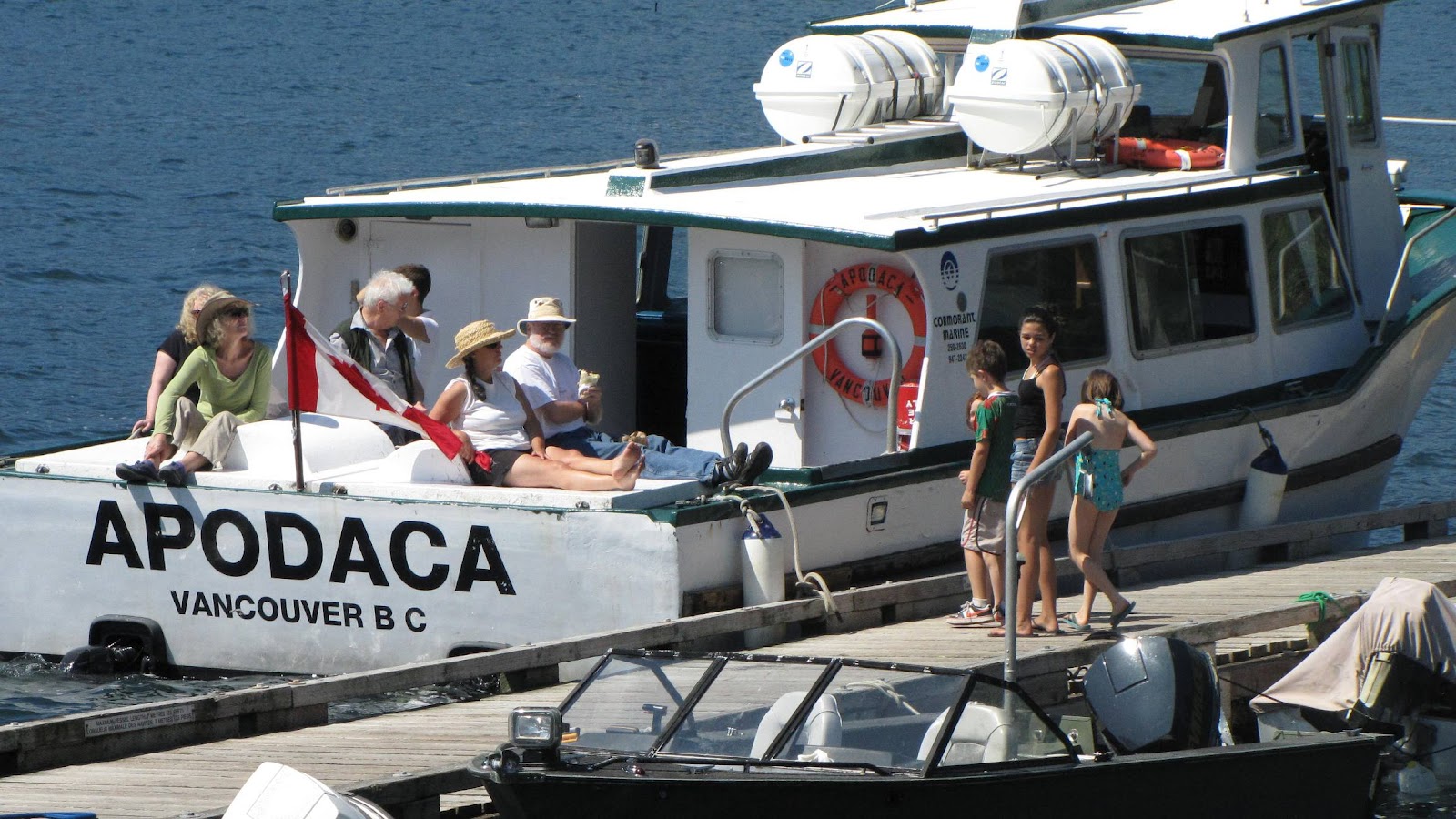 |
| Lunch on the Apodaca! - photo by Wendy Seale-Bakes |
 |
| Black Bear eating barnacles - photo by Wendy Seale-Bakes |
 |
| Gulls - photo by Wendy Seale-Bakes |
 |
| Herons - photo by Wendy Seale-Bakes |
 |
| Lighthouse - photo by Marge Swain |
 |
| Seal - photo by Marge Swain |
Saturday, April 7, 2012
Photos of Herons nesting in Snug Cove April 5-7 2012


The great blue herons are back in their nesting colony behind the Bowen Library (Old General Store) in Snug Cove.
I took a number of photos including mating, nest building and occupation of nests by pairs (male and female).
The quality of images is not the best, the mating and nest building occurred near dusk. Also, to ensure that I did not disturb the mating rituals, I restricted myself to the sidewalk and grassy verge along government road and kept to designated trails in Crippen Park.
I saw three active nests.
Please report any sightings of herons in trees to Bowen Heron Watch (Sue Ellen Fast at sefast@shaw.ca or Alan Whitehead at alanjw@telus.net ).
Photos by Will Husby
Top: 2 pair of herons occupying nests
Middle 3: Heron gathering twigs to ad to nest.
Bottom: A pair of herons mating on nest
Wednesday, May 11, 2011
Our Island's Geology
Kids, Parents and Teachers from Bowen Island's Island Discovery Learning Community explore a local clay deposit with geologist and mayor Bob Turner:
Subscribe to:
Posts (Atom)